Expectations
I hope my legacy isn't power and status. I find fulfillment in understanding things, building things, and helping make the world better. I hope you'll do the same.
What is a PhD?
The original purpose of a PhD is to create a new independent research scholar. During your time in the group this also means preparing you for the next steps in your career--which likely will be outside academia for many of you.
What do I expect from you?
I am your advisor—not your supervisor, or teacher. Often, I don't know the answers to our research questions either.
Core Expectations
First and foremost, adhere to our group's values. Have ideas and work hard on them because you genuinely find them interesting.
I hope you strive to leave a mark, so people might say, "she's the person who did X." Achieving this typically requires growing independent of my ideas and pursuing what truly drives you. This direction often isn't clear at the beginning of a PhD, but I want you to reach that point and will support your journey there.
Think for yourself and from first principles. After time in any field, avoiding "group think" becomes difficult. Question everything—what I say, what the field says. Do things others don't do but should do.
Specific Expectations
Take ownership. If I start caring more about your project than you do, something is wrong. Don't do things just because someone told you to. Understand why you're doing what you're doing. Only one person has solely your best interests in mind—you. My interests will largely overlap with yours but won't be identical.
Communicate openly. You cannot expect telepathy. Tell me if you see something you dislike, could improve, or that annoys you. What seems obvious to you may not be obvious to others. That is, manage up and tell me if something does not work for you. (See: "The care and maintenance of your adviser")
Iterate rapidly. Your first ideas will likely fail—that's normal. Deal with this by executing and iterating as fast as possible, not by thinking your way to the perfect solution. (See also the importance of velocity).
Take action and use your judgment. Don't ask for permission—rather ask for forgiveness. If you wonder "should I do this experiment?" the answer is probably yes. When the worst outcome is reversible (no serious reputation risk and <1k cost), take the decision you think is best—not a guess, but something you've thought through that aligns with our vision and values. The same holds when I leave things vague: I'm trusting you to decide, and if you concretize something I left open, I won't hold it against you. I'd rather you act and we course-correct than wait and have nothing happen. I don't want to decide how you write your notes—but I do want you to keep lab notes; I don't want to prescribe the format of a pitch—but I do want you to make one; I don't want to choose between random forests and XGBoost—but I do want you to justify the choice.
Produce outputs. You'll be evaluated on your outputs. Your projects don't have to succeed—most will fail—but you must conduct real experiments that produce real data we can examine and learn from.
On caring
I mentioned "caring" above. Long hours are not the point of "caring". I won't be impressed to find you sleeping under your desk.
I like to keep in mind that we are on the receiving side of a large gift: taxpayers, foundations, and companies pay us to explore, do science, learn, and advance our careers. I'm still amazed that during my PhD I was the highest earner in my family — even adjusted for the Swiss factor. From that I derive a moral obligation to care — about the quality of our work, about doing the most impactful things we can with the resources we have, and about being genuinely committed to solving the obstacles we hit. And the cool thing is that in the end we get to be proud of having cracked a really hard nut. If this job feels like a mediocre-paid transition to something else that you'd "really want to do" that doesn't align with the group — let's flag it as early as we can.
I don't expect you to be a black belt in research or to work inhuman hours. But I do expect you to care — and concretely, that means three things.
Do rigorous, honest science.
- never leave things broken, and document results so that anyone — including you in ten years — can fully retrace how they were generated
- don't exclude negative findings or spin results
- understand the limitations of the techniques you use, and how your work fits the broader literature and context
- keep improving things that can still be improved
Communicate and critique well.
- proactively communicate with collaborators, with enough context that others can follow
- be very harsh on the content but very understanding and supportive of the person
- tell me how to improve or grow the group — feedback is the greatest gift
Work on the right things — and know when to stop.
- make a plan before you invest heavily, and start writing early (before you start, working backwards) to check the project really solves an important problem — see our Project Lifecycle
- stop projects that are no longer the best use of your time; beware the sunk-cost fallacy
- focus on work aligned with the group's vision while you're part of the group
I can't give exact rubrics for these — they look different for every person, and I don't expect you to be perfect on all of them. Nobody is. What I do expect is that you try hard to get there. If I have to push you to raise the quality, that itself is a sign there's still room to care more.
These are incredibly high expectations. But we are on the receiving side of a tremendous gift — and they come with an equal commitment from me. If you strive to meet them, I'll write you the most stellar reference letters I can, give you every connection I have, push your work and your career with all my strength, shield you from admin and other BS, and give you as much freedom as possible.
There is also real uncertainty out there: the job market is hard, and I can't guarantee funding — not even my own (I might not have a job myself in 2029). The best we can do is stay optimists, care, and do the best work we can. The quality of the work will show — and you'll have every reason to be proud of yourself.
Work-Life Balance
While we strive for impactful, ambitious work, we shouldn't sacrifice well-being and happiness..
Key principles:
- Your personal well-being matters more than work
- Take vacation days 100% guilt-free—enjoy quality time with family and friends without diluting it with work
- Sick days are not vacation days
- Leverage academia's freedom—intense periods alternate with slower ones; rest when exhausted during slow periods
- You're not expected to work evenings or weekends unless facing immovable deadlines and managing time well during the week
- Keep core hours free for in-person interactions (see Daily Operations); if family obligations require different hours, tell me what works best
Get stuff done
Perhaps the most valuable result of all education is the ability to make yourself do the thing you have to do when it ought to be done whether you like it or not. -- Thomas Henry Huxley
Scarcity is value. Most projects start exciting, then stop being fun. That low point is the dip — and it is the worst place to quit, because pushing through what is hard is exactly what creates value. The lesson isn't "never quit"; it's to quit many things early, then commit fully to the one worth pushing through the dip.
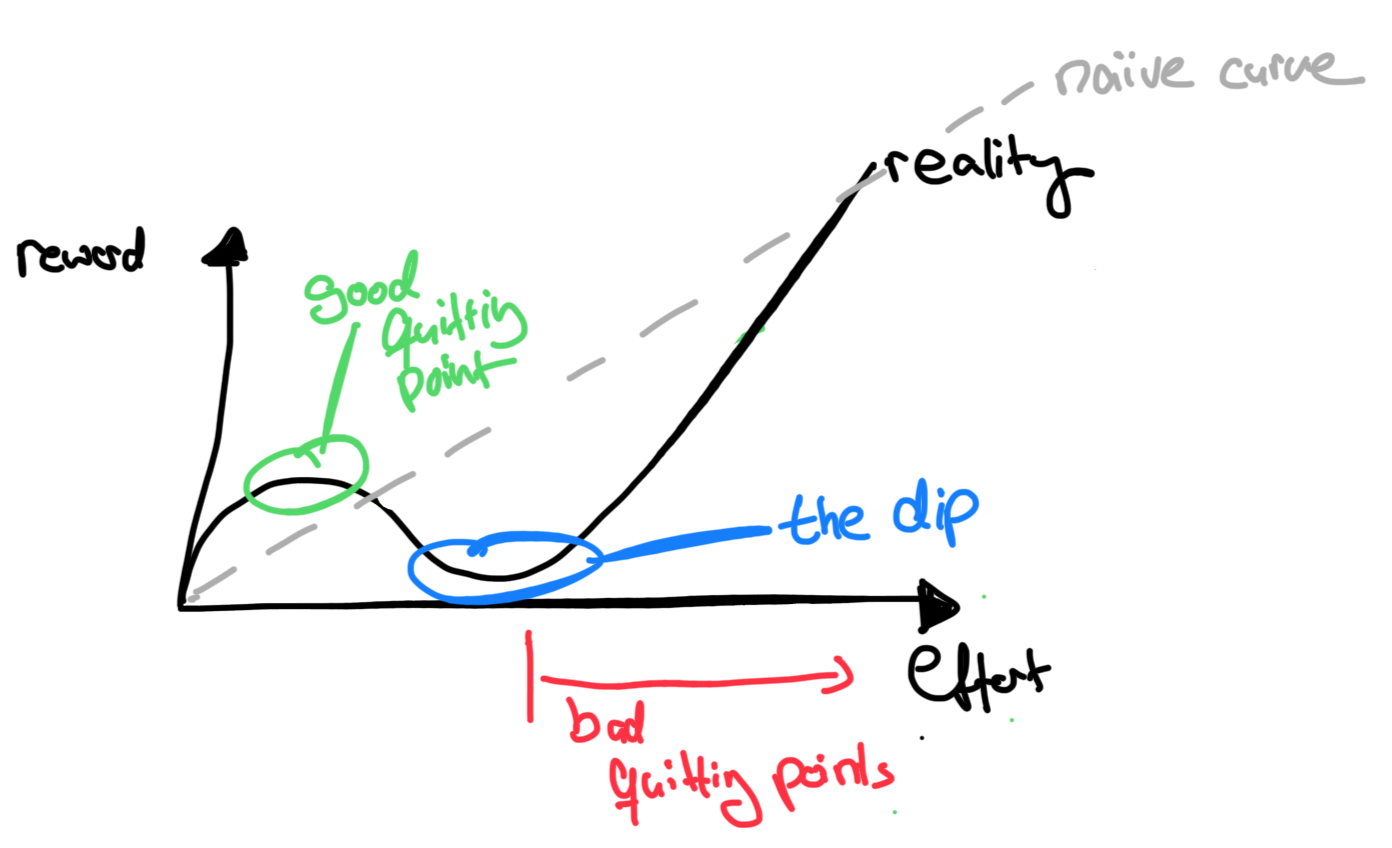
Getting things done also eliminates job worries: as Elbert Hubbard noted in 1899, capable people always find opportunities.
Plot a lot, be obsessed with your data
It is easy to believe you understand what your pipeline is doing. In practice, I almost always find there are still bugs and that I don't really understand what is going on. So plot a lot — every input, output, and intermediate step — and plot it differently until you actually understand it. There is some overhead up front, but it saves enormous time later.
I am a very visual thinker: if you want my help, show me plots.
Day-to-day
Daily operations
Beyond the official rules from the institute/university:
- Any absence (vacation, sick leave, work from home) must be indicated in the Group Calendar. I need to know where you are in case something happens here (e.g., the fire alarm goes off and the fire brigade needs to know who is in the building).
- If you have commitments to external collaborators near a vacation or absence, resolve them before you leave or communicate the delay to all parties in advance.
- If you are sick, please stay at home. If you are not well enough to work, you should not come to the office.
- I would like us to be in the office in person most days for core working hours of 10:00–16:00.
- You must take lab notes. Lab notes are both a legal requirement and valuable for your own research process. If using GitHub and Wandb as lab notebooks works for you, great. If you prefer our group Notion or another system, that works too — the key is having documentation of your work that is accessible to the group.
- If we curse or talk bad about someone else's work without specific reasons or context (e.g., "this is stupid") we deduct cake points in the GroupOS. This is to avoid negative talk without context. If you have a problem with someone's work, address it constructively. This applies to all violations of the Code of Conduct.
- At a university, most things are bought with taxpayer money. Treat shared resources with care — this includes infrastructure such as toilets.
Scientific outputs
- Run any scientific output (paper, abstract, poster, collaboration request, ...) by Kevin before it leaves the group.
- Add any output (poster, talk, presentation, award, ...) you produce to our database.
Meetings
For how meetings work — preparation, attendance, and follow-up — see Meetings and Rituals.
The key points:
- Attendance: If you're invited to a meeting — especially with external collaborators — your attendance is expected unless you've discussed a conflict with Kevin in advance. "In advance" means as early as possible, not the evening before. If something comes up, bring it to Kevin so we can figure it out together. Don't decide on your own not to attend and inform him after the fact.
- Calendar invites: Accept or decline promptly. If you cannot make a Jour Fixe, decline the event so the other person can use the time.
- Jour fixe preparation: See Jour Fixe for agenda requirements.
Travel
See the dedicated Travel page for booking, reimbursement, invoicing, and guest travel guidelines.
Self-Calibration
Several group members have asked for concrete benchmarks to assess their own progress. Knowledge work is hard to measure, and research works in cycles — exploration phases differ from execution phases, and the first year of a PhD looks different from the last. These are not targets to hit every week. They are rough reference points, averaged over longer periods, to help you spot patterns and have informed conversations about your development.
Lenses for Self-Reflection
GitHub activity: Most of our work should be open science on GitHub — documenting the research process and collaborating there. If you're actively doing hands-on research, that should be visible over the course of the year. This is not about lines of code or PR counts, and not a comparison to anyone else — just one lens to consider.
Writing: Writing is thinking. If you're averaging less than 1,000 words per week (across papers, documentation, notes, proposals, etc.), that might be a signal worth examining. Most active researchers naturally write much more when they're fully engaged.
Reading: Are you reading 3–4 papers per week? Reading helps you stay current and generate ideas. It is a long-term investment that might seem like something you can put off for something urgent, but that does not work long-term.
Papers: As a PhD student, averaging at least one core paper per year (where you're the main driver) is a reasonable goal.
Conference travel: Too much travel fragments focus; too little reduces visibility. Find the right balance for your career stage.
Accountability: For the things you commit to, do you regularly underdeliver or overdeliver?
LLM use: How much of your thinking, writing, and coding do you outsource to LLMs? What skills do you lose or not develop this way?
Reflection: Do you regularly step back and reflect on your process and priorities? Do you do your own postmortems to see where you deviated from plans and why? When you come to jour fixes, are you bringing your own ideas and asking for feedback, or primarily asking for solutions? Both have their place, but as you progress, you should increasingly be the source of ideas and plans. Do you know where you're heading and why? Do you reflect on how your profile compares to the pool of applicants for positions you'd want?
Using these benchmarks
If you look at these and feel good about where you are — great. If you see areas you'd like to develop, bring them to a jour fixe or personal development discussion. The point is self-awareness, not pressure. If you're going through a difficult period — illness, personal challenges, burnout, feeling stuck — talk to Kevin about it. We can figure out what support would help, but that partnership requires honesty from both sides.
What can you expect from me?
I will adhere to our group's values—call me out if I don't. You can expect availability for advice on research projects and career questions.
Above all, you can expect an open ear in every situation. Whatever is going on — a project falling apart, a conflict, a personal crisis, doubts about whether this is even the right path — bring it to me. I will hear you out and work with you on it. I will also tell you honestly when things aren't going well; that comes from the same place as the support, not a different one. There is a safety net here, and this group is meant to be a safe space — you are safe when you struggle, not only when you succeed.
Specific commitments:
- Individual personal development plans revised annually
- Project ideas, especially early in your career
- Career advice and network support
- Technical guidance on projects
- Collaborator on code and paper
- Feedback that pushes significant growth
- An environment enabling your highest-standard work—tell me what would help you work better, more efficiently, or more conveniently
I'm ultimately responsible for everything in the group. Blame typically goes to me, not you. Credit goes to you—your career benefits more from recognition than mine does.
Reference Letters
I want to be transparent about something. When you apply for jobs, I will write you the strongest reference letter I honestly can. I want to advocate for you. But a reference letter reflects what I've observed — your reliability, your independence, your collaboration, your output. If I've seen you deliver consistently, meet commitments, communicate well with collaborators — that's what I can write about enthusiastically. If I've seen missed deadlines, dropped commitments, and collaborators chasing me for updates — I can't pretend otherwise. I won't sabotage you. But I also won't invent strengths I haven't seen. The best thing you can do for your reference letter is to give me things to write about.
What you shouldn't expect from me
Don't expect detailed plans and solutions for research questions. If I already knew the answers, research would be pointless. I'm happy to discuss different approaches to problems, but if I could write detailed project plans, these would be engineering projects, not research.
Perhaps also give "Your Advisor Has Five Impossible Jobs" a read.