Corral#

Corral: The unified framework for the science of agents and agents for science.
This dual focus means Corral provides extensive utilities that not only facilitate research into agent methodologies but also simplify the creation and deployment of scientific agents and scientific environments.
Corral is built and maintained with the following foundational principles in mind:
-
Research Facilitation (Science of Agents): Ensuring comprehensive monitoring and control of all system changes, crucial for enabling detailed scientific studies, ablations, and a deeper understanding of agent behavior
-
Enablement (Science of Agents): Streamlining the practical development, deployment, and evaluation of agents tailored for scientific research and applications.
-
Reproducibility: Facilitating consistent and repeatable research outcomes.
-
Control: Providing precise control over all environmental and agent variables.
-
Efficiency: Designed to be lightweight and portable.
-
Simplicity and Usability: Engineered for ease of understanding and straightforward application.
-
Flexibility: Empowering diverse approaches through extensibility, free from rigid constraints.
-
Decoupled Design: We decouple agents from the environment.
Environments 🌍#
- The
Environmentis the "world" with which an agent or human interacts. In real world for a chemist doing synthesis, environment would be chemistry lab and for a computational scientist their PC/ HPC with softwares and internet. Environments define the task space (Task and the different ways to solve them) that include use of tools. Good environments give observable feedback for the agent, allowing it to make its next move.
In Corral, all resources and capabilities that an agent might leverage – such as specific APIs, code interpreters, or specialized data stores – are considered intrinsic components of the environment itself. This architectural choice ensures that environment design is explicit about available tools, facilitating rigorous control, strict reproducibility, and clear separation between the agent's decision-making logic and its interactive substrate.
The platform includes several pre-built environments:
| Environment | Description |
|---|---|
corral_samplemath |
Basic mathematical operations |
corral_spectra |
Spectroscopy data analysis |
corral_molecular_dynamics |
Molecular dynamics setup |
corral_open_catalyst |
Catalysis research tasks |
corral_afm |
Atomic force microscopy |
corral_retrosynthesis |
Plan synthesis |
corral_resistor |
Infer circuit topology |
corral_wet_lab |
Virtual lab for ion analysis |
corral_simple_ml |
Basic ML modeling |
Agents 🤖#
Agentis the entity responsible for perception (observing the environment) and decision-making (deciding what actions/steps to take) to solve the task. Agents are made with LLMs in many fancy ways (commonly called scaffolds).
Corral treats agents as modular components, emphasizing the agent's internal architecture and learning/inference mechanisms. This modularity allows researchers to develop, train, and evaluate diverse agent designs independently of the specific environmental configurations.
The platform includes several built-in agent types:
| Agent | Description |
|---|---|
ReAct |
Uses the ReAct (Reasoning and Acting) framework for step-by-step problem solving. |
ToolCalling |
Uses native function calling from LLM providers to solve tasks by leveraging built-in tool/function calling capabilities. |
LLMPlanner |
Uses hierarchical planning with high-level planning and low-level execution delegation to other agents. |
Reflection |
Empowers agents to self-evaluate their past actions and reasoning, learn from errors, and refine future strategies or plans. |
Task 📝#
- A
Taskdefines the problem an Agent is intended to solve within a particular Environment. It specifies the criteria for successful completion, and often includes a reward structure or performance metrics used for evaluating the agent's efficacy and efficiency.
In Corral, a task typically encompasses the core objective and can optionally include constraints that the agent must adhere to during its execution (e.g., allowed tools). Furthermore, tasks often integrate a scoring function (or callback) that quantifies the agent's performance, allowing for automated evaluation.
In Corral we have defined a container called TaskDefinition that could be used to represent a Task, while it is present it is not necessary to use it
///info
An example of defining a task using TaskDefintion
from corral.backend.task import TaskDefinition

task1 = TaskDefinition(
    name="retrieve_data",
    description="Retrieve molecular structure",
    tools=["database_query"],  # you can pass a list of tools
    scoring_fn=data_score,  # this is a python callable function
    submission_format={"structure": "string"},
    initial_input={"molecule_id": "mp-149"},
)
Corral also supports chaining tasks together: a linked task is a normal task whose input_map references other tasks' outputs. Linked tasks are solved in dependency order, with the output from one task serving as input or context for the subsequent tasks. At runtime, the linked environments share a single run store through their CorralState, while the dependency graph is derived from the task definitions themselves. This powerful capability allows for the construction of arbitrarily complex, multi-stage research challenges that mirror real-world problem-solving processes.
///info An example of defining linked tasks
from corral.backend.env import build_environments
from corral.backend.task import InputRef, TaskDefinition

# Define tasks with dependencies
task1 = TaskDefinition(
    name="retrieve_data",
    description="Retrieve molecular structure",
    tools=["database_query"],
    scoring_fn=data_score,
    submission_format={"structure": "string"},
    initial_input={"molecule_id": "mp-149"},
)

task2 = TaskDefinition(
    name="analyze_structure",
    description="Analyze the retrieved structure",
    tools=["structure_analyzer"],
    scoring_fn=analysis_score,
    submission_format={"result": "dict"},
    input_map={"structure": InputRef("retrieve_data")},  # Depends on task1
)

# Create one environment per task; grouping is derived from the graph and
# linked tasks share their outputs through their state
environments = build_environments(
    {"retrieve_data": task1, "analyze_structure": task2},
    base_work_dir="workdir",
    name="molecular_workflow",
    available_tools=my_tools,
)

# Access input from previous task (resolved from the shared state)
task_input = environments["analyze_structure"].state.resolve_inputs(task2)
Through this formalism, Corral provides a flexible and robust framework for defining and evaluating intricate agent behaviors across a wide spectrum of research problems.
Tools#
- Tools are functionalities that can be executed by the agent to do something in the environment.
Corral architecture TL;DR 🏗️#
TaskRuntime appends authored commits for setup, agent turns, tool effects,
and lifecycle events, then materializes the current projection.
execute_task in run.py invokes the task runtime locally or through a Docker
launcher. Task state is persisted in the commit store.
CorralRunner schedules repeated trials with asyncio, including retries,
concurrency limits, dependency readiness, and evaluation. It projects the
results into reports and metrics.
/// info open: True
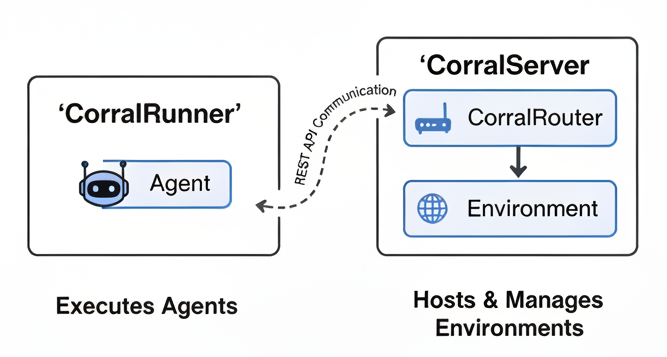
Agents within Corral are designed to interact with their environments primarily using natural language.
///
🔍 Trace Visualizer#
Explore and analyze agent traces with the Trace Visualizer. This tool provides an interactive interface to visualize the traces generated by agents during their interactions with environments, facilitating deeper insights into agent behavior and decision-making processes.
The visualizer also supports annotation workflows: users can mark nodes with behavioral markers, add notes, and submit annotations to a configurable API endpoint. This enables streamlined annotation procedures for research teams, with annotations stored in a database for later analysis.
🤝 Community#
- Issues: Report bugs and request features on GitHub Issues
- Contributing: See our Contributing Guide
📄 License#
This project is licensed under the MIT License - see the LICENSE file for details.