Performance and automatic differentiation
MLX work is lazy and asynchronous with respect to the CPU. Correct benchmarks must materialize outputs before stopping the timer:
start = time.perf_counter()
output = model(inputs)
mx.eval(output)
elapsed = time.perf_counter() - start
Run warm-up iterations before sampling so compilation and kernel caching are
not counted as steady-state inference. The repository’s evals/ harness does
this consistently across Torch CPU, general MLX, and kernel-enabled MLX.
Generated Metal kernels
Tensor products, spherical harmonics, and scatter aggregation can use generated Metal kernels. Dispatch is automatic: compatible kernels fuse indexing, Clebsch–Gordan contraction, weighting, and accumulation; the general MLX path handles unsupported inputs and performance crossover points.
Dense shared-weight tensor products deliberately keep their parameter vector compact. Expanding a shared vector across the batch produces the same forward values but creates a large per-item weight-gradient reduction. The compact execution is used by FullyConnectedTensorProduct and by general shared-weight TensorProduct instructions in every connection mode.
Set use_custom_kernel=False to compare paths or to request the most general
automatic-differentiation behavior. Disabling a kernel changes execution, not
the mathematical operation.
Measured speedups
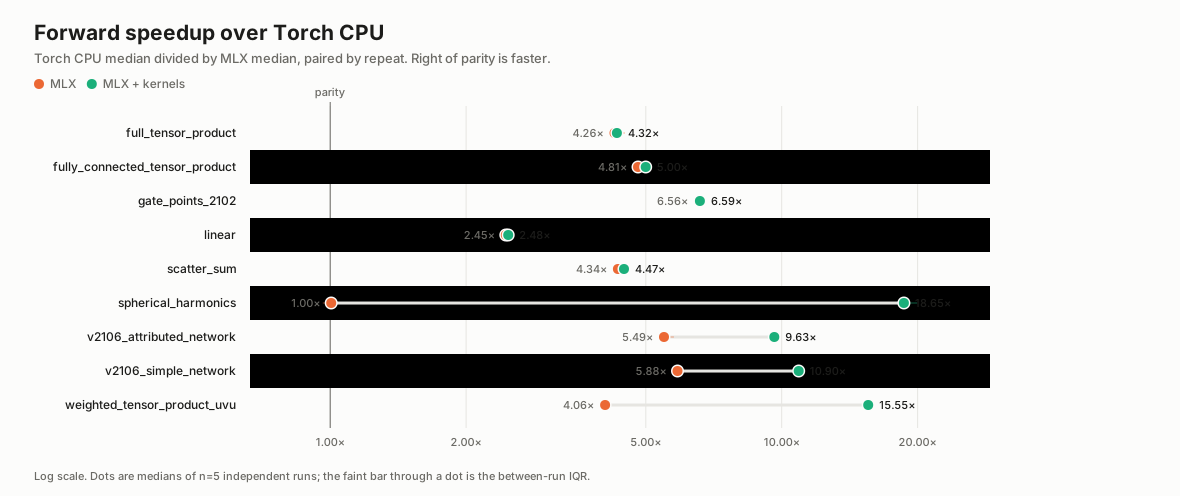
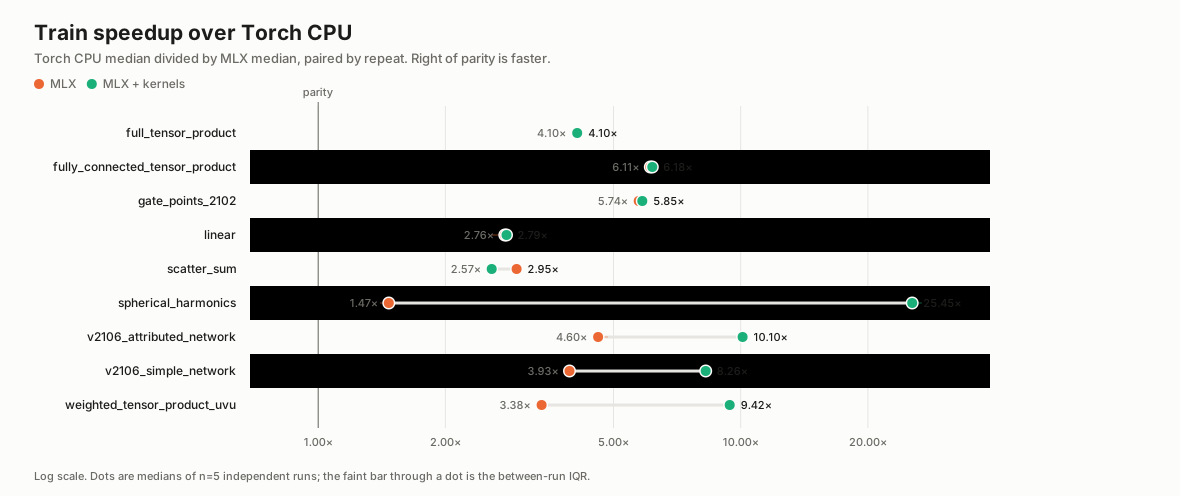
Both figures below plot Torch CPU median / MLX median, so a point to the right of the parity rule means MLX is faster. Each row is one benchmark case, and it carries two points:
orange — MLX: compiled MLX with generated kernels disabled.
aqua — MLX + kernels: the same work with kernel dispatch enabled.
The gap between the two points is therefore the kernel contribution, and the distance from the parity rule is the total gain over Torch CPU. A row whose two points sit on top of each other gained nothing from a kernel.
What each row measures
Row |
Operation |
Kernel path taken |
|---|---|---|
|
Real spherical harmonics of every edge vector — the geometry encoding a point model evaluates most often |
|
|
Per-item learned |
|
|
Aggregation of edge messages onto nodes |
|
|
Every unweighted Clebsch–Gordan output path |
falls back to general MLX |
|
Dense learned equivariant mixing across all paths |
falls back to general MLX |
|
Equivariant multiplicity mixing. Deliberately a control: it has no kernel, so the two points must coincide |
no kernel exists |
|
The full February 2021 gated point network |
model has no kernel toggle |
|
v2106 geometric message-passing network, end to end |
|
|
v2106 with node and edge attributes, end to end |
|
Read the two columns of points separately. Orange shows what MLX gives you for
free — roughly 2.5–6x across the board, and near parity for
spherical_harmonics, where general MLX is no faster than Torch eager. Aqua
shows where a generated kernel then adds something: spherical_harmonics goes
from parity to about 19x, and weighted_tensor_product_uvu from 4x to 16x.
Where the two coincide — linear, full_tensor_product, gate_points_2102 —
the gain is MLX’s, not a kernel’s.
mixed-model-kernels on the two end-to-end networks means kernel-aware
submodules are enabled, not that every operation inside the model uses a
generated kernel.
Why forward and training differ
The training figure is not a second measurement of the forward pass: it is
forward plus backward, and the two phases have different ratios. Taking
spherical_harmonics from the run plotted above:
forward |
backward (train − forward) |
|
|---|---|---|
Torch CPU |
8.87 ms |
20.36 ms |
MLX + kernels |
0.45 ms |
0.65 ms |
ratio |
19.9x |
31.4x |
Torch’s autograd for spherical harmonics costs 2.3x its own forward pass, while the kernel’s backward costs 1.5x its forward. The training number is the blend of the two phases weighted by MLX’s time in each, which is why it lands at about 25x — between the forward and backward ratios, nearer the backward one because backward dominates the total.
This also means a row can move in either direction between the two figures.
scatter_sum drops from 4.5x to 2.6x because its backward is comparatively
cheap for Torch, while spherical_harmonics rises for the opposite reason.
Regenerating these figures
.venv/bin/python evals/run.py --preset full
cp evals/results/<timestamp>/plots/speedup_*.svg docs/_static/
The numbers quoted here come from one five-repeat run on one machine; treat them as the shape of the result, not as a specification. Each point is the median of the paired per-repeat ratios, so a single slow repeat does not move it.
Kernel limitations
Kernel-enabled execution is an adaptive policy, not a promise that every operation uses a custom kernel. Unsupported shapes and measured crossover points fall back to general MLX without changing results. Benchmark reports record the selected path so a fallback is not reported as kernel execution.
Generated kernels require Apple Silicon with Metal and currently operate on
float32. Other devices and dtypes use general MLX.Tensor-product kernels require rank-two inputs with equal batch size. Weighted calls additionally require the exact supported shared rank-one or unshared per-item rank-two weight layout.
Sparse scalar-path tensor products are capped at 2,000,000 generated terms, a batch size of 512, and 2,000,000 batch-times-path terms. Above these crossover guards, batched general MLX contractions are faster and are selected automatically. Dense shared-weight
FullyConnectedTensorProducttherefore normally uses general MLX.The channel-local kernel is specialized for weighted
uvuinstructions with unique output blocks, uniform channel multiplicity, and unshared per-item weights. It is the important large-edge-count message-passing specialization; other connection modes use scalar-path kernels or general MLX.The generated spherical-harmonic kernel accepts nonempty rank-two
float32vectors throughl=4. Higher degrees, empty inputs, and additional leading dimensions use the general recurrence.Generated scatter accepts nonempty rank-two-or-higher
float32sources and eager, valid indices. Its atomic accumulation can be slower than MLX indexed-add for some shapes, so it is opt-in and should be benchmarked for the target graph.Kernels currently operate on individual primitives. Message tensor products, radial weighting, and scatter are not fused into one graph-level dispatch, so intermediate message arrays still consume memory.
The shipped gate_points_2102 model currently has no model-level kernel
toggle and always uses its general MLX tensor-product and scatter paths. The
v2106 models propagate the toggle, but remain mixed executions because dense
and unsupported operations fall back automatically.
Compilation and generated-kernel startup are reported separately by the evaluation suite and excluded from steady-state latency. For short-lived or small workloads, startup can outweigh the steady-state gain.
Differentiation boundary
Reverse-mode gradients and reverse-over-reverse second derivatives are
supported by generated kernels. MLX cannot currently apply JVP directly to a
CustomKernel primitive. JVP users—Hessian-vector products, phonons,
directional response, tangent dynamics, and forward-mode sensitivity—should
use the general path:
output = tensor_product.differentiable_arrays(left, right, weights)
harmonics = o3.spherical_harmonics(
    degrees, vectors, use_custom_kernel=False
)
For graph reduction, use
scatter_sum(..., use_custom_kernel=False, jvp_safe=True). MLX 0.31’s
indexed-add primitive does not implement JVP, so this fixed-index fallback uses
a sparse sorted prefix sum with linear memory. Ordinary scatter calls retain
the faster indexed-add implementation.
See the repository’s evaluation guide for the compact three-way benchmark and randomized numerical parity suites.